
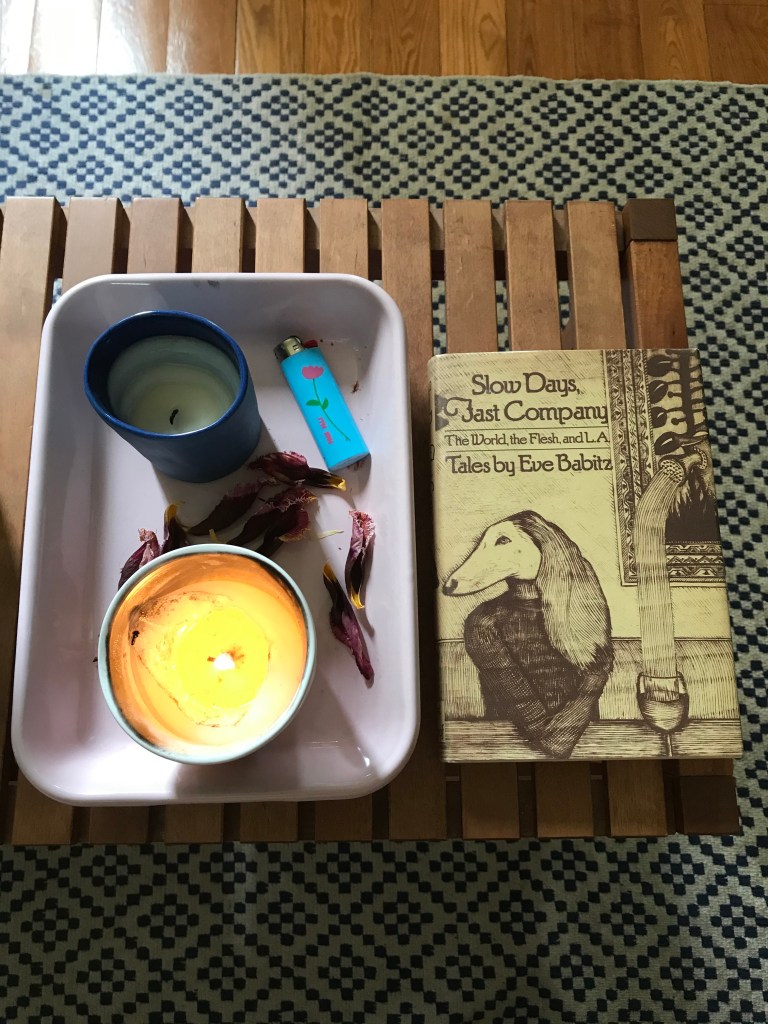
After various attempts at getting this book before trips to LA, I finally got my hands on a 1977 copy the day I was leaving the city. I wound up reading this book months later, notably not in an airplane flying over Babitz’s beloved city as I had imaged, but in various places around New York City–the crowded subway, a park in Brooklyn, a chair in the corner of my bedroom placed directly in front of the air conditioner on a particularly hot day, behind the service desk at my part-time library job (before I found out that was not allowed). But the fact that my initial high-flying plan did not work out ultimately didn’t matter, because Slow Days, Fast Company has a way of transporting you through time, cultural spaces, emotions and genres.
The text is broken up into ten autobiographical tales that explore the LA scene Babitz was entrenched in, with each one captivating in its own right. The prose are filled with the type of honesty and irony that I imagine someone who grew up in Hollywood would need to cultivate in order to maintain any sense of self. She has a method of weaving stories and portraying experiences in a way that makes you want to observe the world, become a writer, take cocaine, live in LA in 1960; and she does so without pretension. Even to the (unfortunately) universal and (sadly) timeless discussions about weight, body, and beauty, she brings a sense of nuance and self-awareness so that it becomes impossible (thank god) to write these topics off as superficial. Overall Babitz discusses love affairs, friendships, suicides and baseball games–each with the same carefully crafted style.
It is nearly impossible to read this book without Googling every person,location, restaurant and flower that is mentioned (I can confirm that Jacaranda trees are gorgeous and Port’s Restaurant is sadly no longer in business). If this book contained hyperlinks it would lead you down many a Wikipedia rabbit hole where you’d find traces of Babitz’s links to the cultural scene of the time–Jim Morrison, Harrison Ford, Ed Ruscha and Paul Ruscha, whose photo of Eve adorns the back of this vintage copy. Yet, the book pushes beyond this Wikipedia persona and the notion of Eve as muse; instead portraying the LA scene as Eve’s muse. Further, the text addresses things like friendships, relationships and the value we put on each. “’Just Friends’ they’re called. An American distinction if ever there was one. Only we would say ‘just’ about a friend” (74). Similarly, one of the main struggles throughout the book is this frustration with dichotomies and always having to choose––between men and women, friendship and love, food and thinness, fun and marriage, LA and the rest of the world. Towards the end of the text Babitz remarks, “I wonder if I’ll ever be able to have what I like or if my tastes are too various to be sustained by one of anything”(38). OOF.
Ultimately, I often wonder in books like this if the writer lives their life in such a way so that it can be used to make their writing shine. If each line of coke, or trip to Palm Springs, or friendship with a millionaire is done to sustain their time in front of the type writer. Regardless, I’m glad this book was written, and I think we are all lucky it was Eve Babitz who wrote it. Sure, there’s probably a number of functional alcoholics from the late 1960s LA scene who rubbed shoulders with fascinating people. Who thought about life and death. Rode in fancy cars. Yet, there’s something about the way Eve captures it all. The way she simultaneously questions it and promotes it. The way she acts impulsive one minute and contemplative the next. There’s a pace to her stories and a poetry to her observations that makes her writing distinctive, and often funny. When people say that a character has to have ~voice~ this is what they mean-Eve Babitz.
RATING:

 Sarah's Shelf
Leave a comment