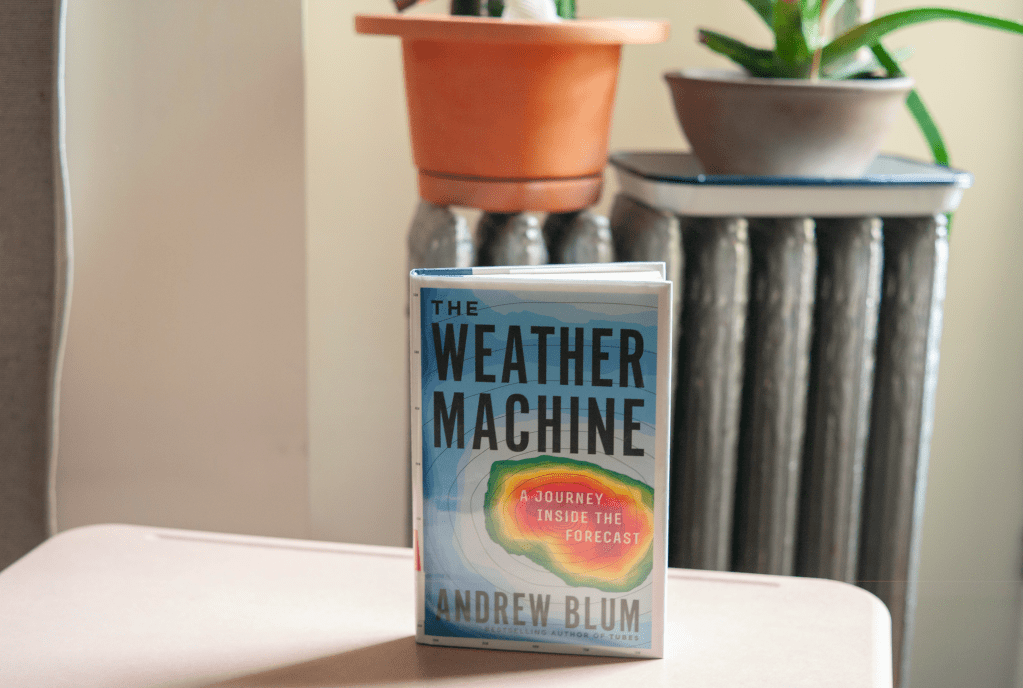
Things I do everyday, multiple times a day–obsessively check my weather app on my phone. Things I’ve thought about, maybe never–what goes into putting that information on my phone.
Honestly, weather seems to rule my life. As someone who ran competitively for about 8 years, runs recreationally now, and uses a bike as my main mode of transportation, I truly find myself checking days in advance what the weather will be like. I plan my life and schedule around the weather and find myself getting SO anxious about how rain, heat or snow will affect my ability to bike.
So when I heard the 99% Invisible episode featuring Andrew Blum, author of “The Weather Machine: A Journey Inside the Forecast” I was completely intrigued. I picked up a copy of his book and found it to be such a quick and accessible read (especially for someone who admittedly does not know much about this stuff).
The book takes you on a historical and geographical journey as Blum explains the evolution of weather technology. There’s fascinating little factoids like how in 1855 when the Smithsonian Meteorological Observation Program used a giant map in their lobby to display weather from all over the United States. Volunteers and paid, “Smithsonian Observers” would send weather reports from all over and different colors–white for fair weather, brown for clouds, etc–would indicate the weather conditions throughout the country. In the 99% Invisible episode Roman Mars describes this as a “beautiful, quirky analog, fun thing” which I think is just the best description ever.
“We learned to see the whole world thanks to the technology built to destroy the whole earth”
But some of the things I found most interesting were the ways that Blum exposes the ironies in the development of the weather system. And by that I mean, the ways that the developments in weather technology is inextricably linked to our military and military weapons. Throughout the book Blum emphasizes the harsh fact that “we learned to see the whole world thanks to the technology built to destroy the whole earth,” (74).
Blum also dives deep into “weather diplomacy” even going in to Geneva in 2015 for the World Meteorological Congress. In exploring this concept of weather diplomacy, he discusses a lot of things that I, as a librarian, find super interesting. Namely, the ideas of free dissemination of information, open data, and access to information. Blum asks us to consider what will happen when (not if) “billions of tiny temperature and barometric sensors- in smartphones, home devices, attached to buildings, buses or airliners” start competing with the carefully constructed weather stations of the Regional Basic Synoptic Network? (171). While the Government weather services have a history of giving their services away for free, how will companies like Google, IBM and Amazon handle openness? Blum seems to think the weather system is in for a big change as the structures it was built on continue to change: “How was an organization organized by nation-states, committed to open data and borne of a global view supposed to work in a world in which the default mode of information was to live on private platforms and travel across private networks?” (177). An important question that was top of mind at the 2015 World Meteorological Congress, and I’m sure continues to be today.
How long can the current system of data exchange among nations hold? How soon might it be supplanted by global technology corporations–themselves often acting like nations?
In many ways the book doesn’t end on the highest note. Blum writes, “The weather machine has to be a global system, and it won’t work any other way. At its heart is an equilibrium between the things nations do for themselves and the things they contribute to systems that supersede their borders… And yet, the technological winds are blowing against us. The most important weather observations are increasingly collected by the narrow tier of countries that operate satellites. and the most important forecasts are produced by the equally slim group of countries (or groups of countries) that operate weather models. How long can the current system of data exchange among nations hold? How soon might it be supplanted by global technology corporations–themselves often acting like nations? The weather machine is a last bastion of international cooperation. It produces some of the only news that isn’t corrupted by commerce, by advertising, by bias or fake-news,” (181). After spending approximately 180 pages falling in love with the weather system, this was a hard thing to read. But I think he’s right, the structures of society are changing so drastically because of how companies are expanding (ahem, Elizabeth Warren has definitely talked about this). Still, Blum makes clear that there are extradoinary benefits to us keeping the structures of weather the weather machine in place, and I found these reminders comforting somehow. Like how could this be destroyed when it’s so beneficial? (Don’t answer that). But really, the system is meant to help reduce the impacts of natural disasters, make transportation safer, and help people use natural resources more sustainable. Like, WIN WIN WIN WIN. And for those who are counting, the World Meteorological Organization “estimates the economic value of weather services in excess of $100 billion annually, while the cost of providing them is a tenth that,” (175). John Zillman, a former head of the Australian Weather Bureau puts it well saying, the whole thing can be thought of as “the most successful international system yet devised for sustained global cooperation for the common good in science or in any other field,” (175). Ya know. No big deal…
Ultimately, I really enjoyed this book. I thought it was occasionally repetitive (when I was pulling quotes from my notes I had like 5 different variations of “we have weather information because of satellites and we developed satellites for military power”. But, it’s an important point so I’ll let it slide. In all seriousness, I think Blum does an amazing job at explaining something I have barely thought about, while also relating it to things I already care deeply about. I highly recommend this book, I just wish I had more information on ways to keep Jeff Bezos away from the weather machine.
RATING:

 Sarah's Shelf
Leave a comment